Together against insect decline.
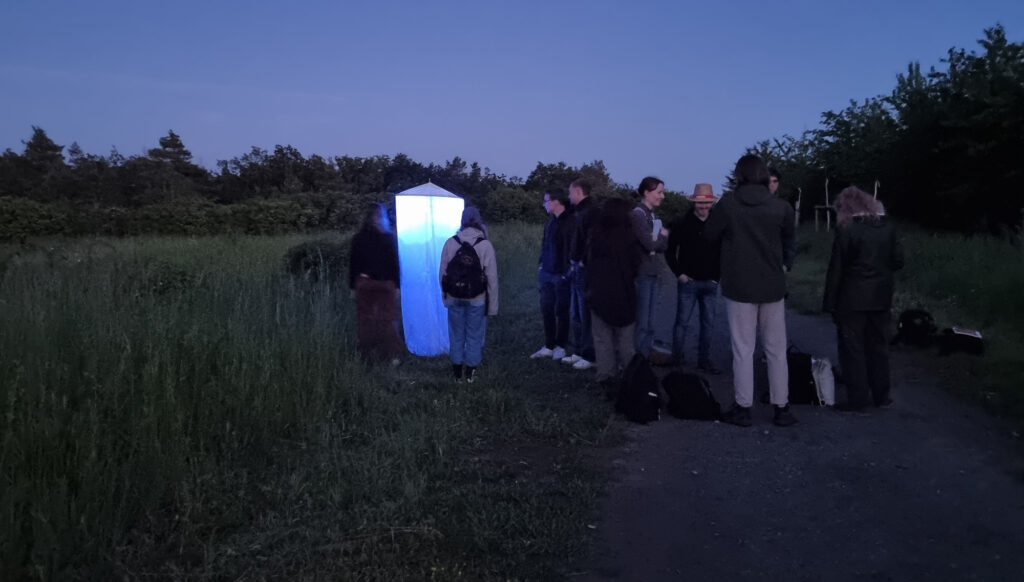
While we rest at night, a hidden world wakes up. Nocturnal insects fly through parks and our gardens, mostly unnoticed, despite their enormous importance. As essential pollinators and a vital food source, they are a cornerstone of our ecosystems. In Germany alone there are more than 3,600 species of moths. But this diversity is increasingly under threat, and we still know too little about where these species actually occur.
This is where you come in!
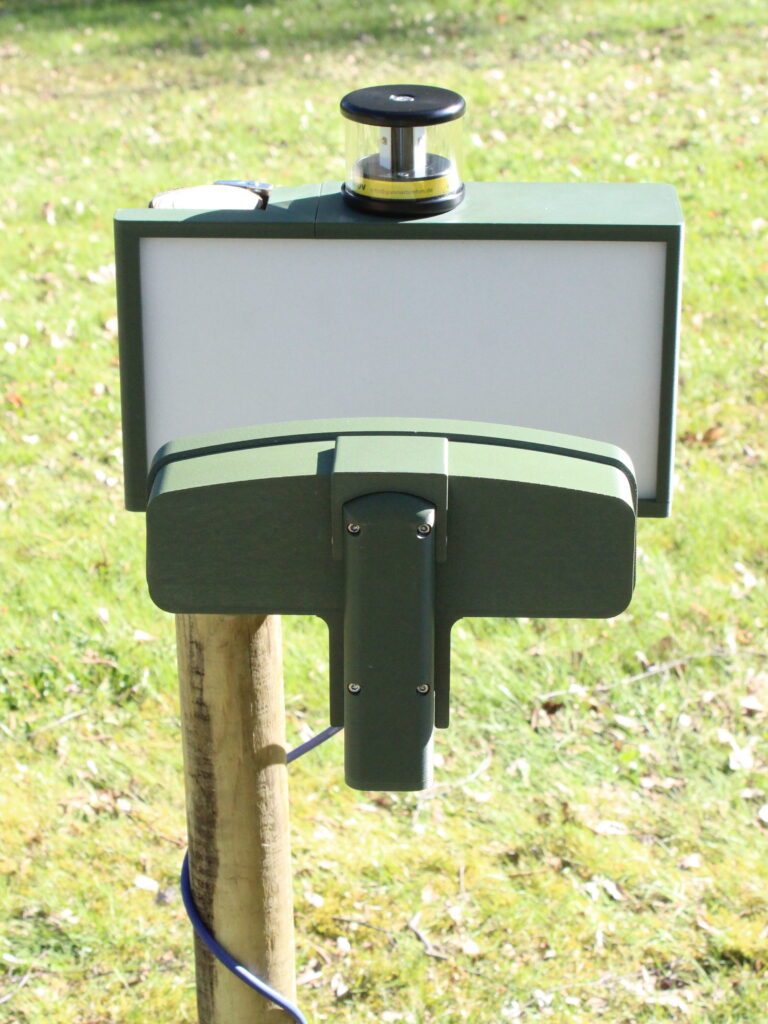
To establish this kind of monitoring, the team in Marburg and Bremen is developing and testing innovative citizen science methods. The project uses a special citizen science version of the ARNI camera, developed by the University of Jena together with K2W and neun&neun. It also uses applications that identify insects automatically with artificial intelligence (AI), which were likewise developed by the University of Jena. Gamification plays an important role too: these are playful approaches that help, for example, to train the AI. They are developed and put into practice together with the team in Bonn.
The Marburg/Bremen team is investigating in practice how experts can pass on biological knowledge about moths to interested people with little or no previous experience. As a participant, you won’t be left on your own. The team supports both the volunteers who run an ARNI-CS in their garden, in a forest, on farmland or in other landscapes, and those who support the project online by helping to train the AI. This close contact between researchers and citizen scientists creates a strong network for protecting our ecosystems at night.
Become part of the research
The LEPMON project uses modern camera technology and artificial intelligence to record and identify nocturnal insects automatically. But to cover really large areas, we need a lot of data and a lot of cameras.
Whether you’re a beginner or an expert, every contribution helps us understand and protect biodiversity.
- You can actively help collect data and make species visible.
- You help us better understand changes in the environment.
- You become part of a network that moves science forward together.
How you can take part
- Digital image analysis: Help us from home by reviewing and identifying insect images on our online platform. At the same time, you train our AI so that it recognises species even more accurately in the future. No previous knowledge is needed. Get started right away: Register here.
- Look after an ARNI camera system: Help us collect images of moths and other nocturnal insects by setting up and maintaining an ARNI camera, for example in your garden, a meadow, a field or an orchard. Apply for an ARNI camera system here: https://redcap.kks.uni-marburg.de/surveys/?s=PYTXTYR7MMJPCJAK
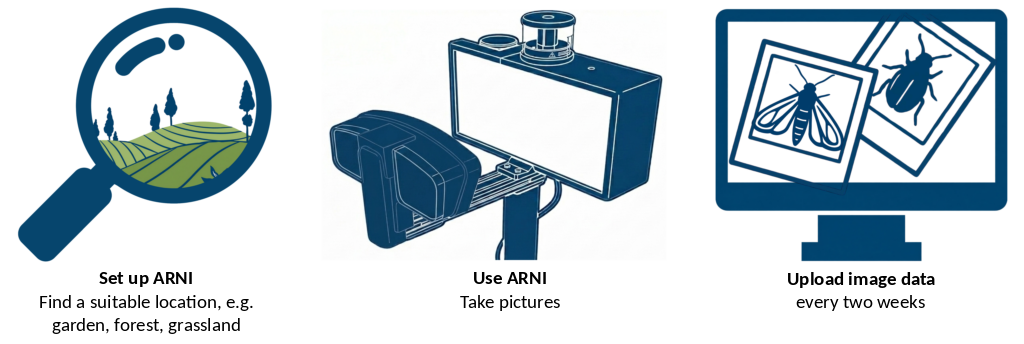
Our support: The project team provides the technical equipment and detailed instructions.
Enquiries: Via our contact form (please select “Citizen science” in the drop-down menu)
Warum ein Teil von LEPMON werden?Why join LEPMON?
“Every image uploaded and every moth identified brings us one step closer to a fuller understanding of how moth populations in Germany are changing.” — Dr Julie Koch Sheard, Citizen Science Project Lead
By taking part, you contribute directly to building a nationwide monitoring system for nocturnal insects.
Join a growing community of moth enthusiasts!
Your contact person
Do you have questions about the project or about taking part?
Dr. Julie Koch Sheard, WG Citizen Science, University of Bremen
📧 sheard[a]uni-bremen.de 📞 06421 28-23490